
Before you start
Apelora Fabric lets you draw an application, then runs it on your own Linux servers. These pages take you from nothing to a running, managed application, one step at a time. Each step links to the page with the details.
Early release. Apelora Fabric is new. Try it on a test cluster or a few spare servers before you rely on it. Seven of the 143 catalog modules deploy today; the others can be designed but not yet deployed.
The parts
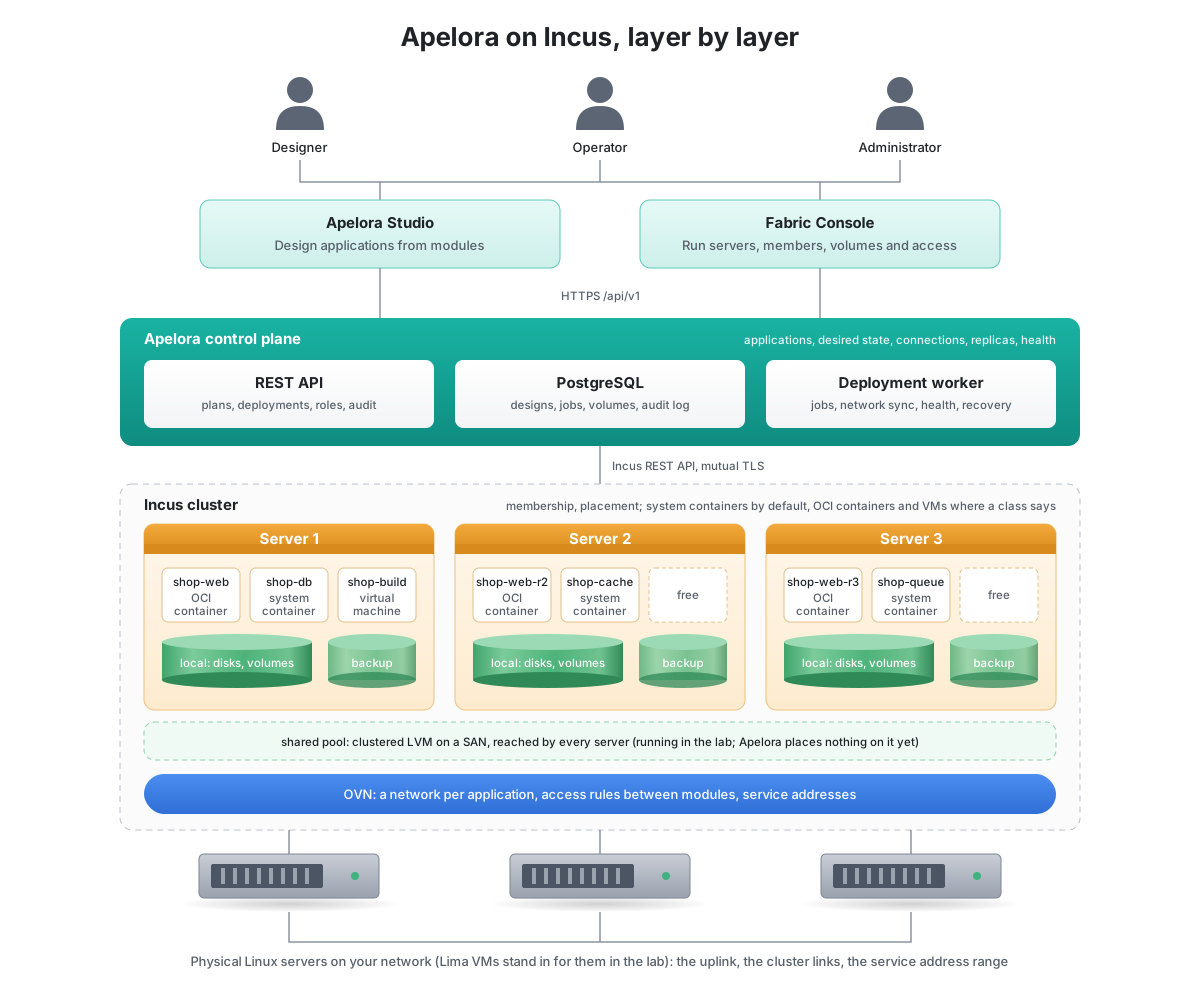
| Part | What it is | Where it runs |
|---|---|---|
| Apelora Studio | The designer, in your browser | Static files, served by any web server |
| Fabric Console | Administration: servers, applications, operations, audit | Static files, served the same way |
| Control plane | The API: plans, roles, audit. Rust, backed by PostgreSQL | One process, next to the database |
| Deployment worker | Carries out jobs, enforces the network, replaces lost replicas | One or more processes |
| PostgreSQL | Apelora's own records. Not your applications' data | Anywhere the control plane and worker can reach |
| Incus cluster | Runs your modules as containers and virtual machines | Your servers: three or more |
Apelora owns the application: its design, its connections, its replicas and their health. Incus owns the servers: membership, placement and the instances. Apelora talks to Incus only through its documented REST API.
What you need
- To try it: a Mac or Linux workstation, Node.js 22 or newer, and for the full test cluster Rust (the repository pins the toolchain), Docker and Lima. No hardware to buy.
- To run it on your servers: three or more Linux servers (kernel 6.12 or newer) with Incus 7.0 LTS clustered; PostgreSQL; a machine for the control plane and worker; and a way to serve two sets of static files over HTTPS.
- To deploy something: an Incus project for Apelora to deploy into, and an identity Apelora may use there.
Choose your way in
- See the designer in a minute. Try it on your workstation, first step. Mock data, nothing deployed.
- Run the whole thing on one machine. The same page, second step: a throwaway Incus cluster in virtual machines.
- Set it up on your own servers. Plan the servers and network, install Incus, then install Apelora Fabric.
Then, in order: sign in, design your first application, deploy it, manage it, and keep when something goes wrong at hand.