
Connections between layers, and how far Apelora scales
Status: reference · Date: 2026-10-21 · Decision: ADR 0008 — sectors · Layers: platform architecture
This page lists every connection between the layers of an Apelora installation — who opens it, over what, how it is authenticated and what happens when it breaks — and then how far each layer scales, with the source of each number. Numbers marked estimate are ours; the others come from the upstream projects.
1. What runs where
| Layer | Runs on | Instances of it |
|---|---|---|
| Fabric Console, Studio | the person's browser (static files served next to the API) | any |
| Control plane (API) | one or more Linux hosts or containers outside the clusters it manages | 1 today; several behind a load balancer once the per-process state below is shared |
| Deployment worker | same | several (jobs are claimed with leases) — except the replica supervisor, see §4 |
| PostgreSQL | a managed or self-run PostgreSQL | one primary, optional replicas |
| Incus | every physical server in a cluster (a member) | one cluster per sector (ADR 0008) |
| Modules | Incus instances on the members: LXC system containers by default, OCI application containers where the module class asks for one, virtual machines only where needed (another kernel or OS, kernel modules, live migration) | replicas of one module are separate instances, usually on different members |
| OVN (when used) | central databases on members of the same cluster; ovn-controller on every member | one OVN deployment per sector |
| Shared storage (when used) | a SAN (iSCSI, Fibre Channel or NVMe over Fabrics) reachable from every member of the sector | one shared volume group per pool |
In the disposable test cluster, Lima virtual machines stand in for the physical servers; nothing in Apelora depends on that.
2. Every connection
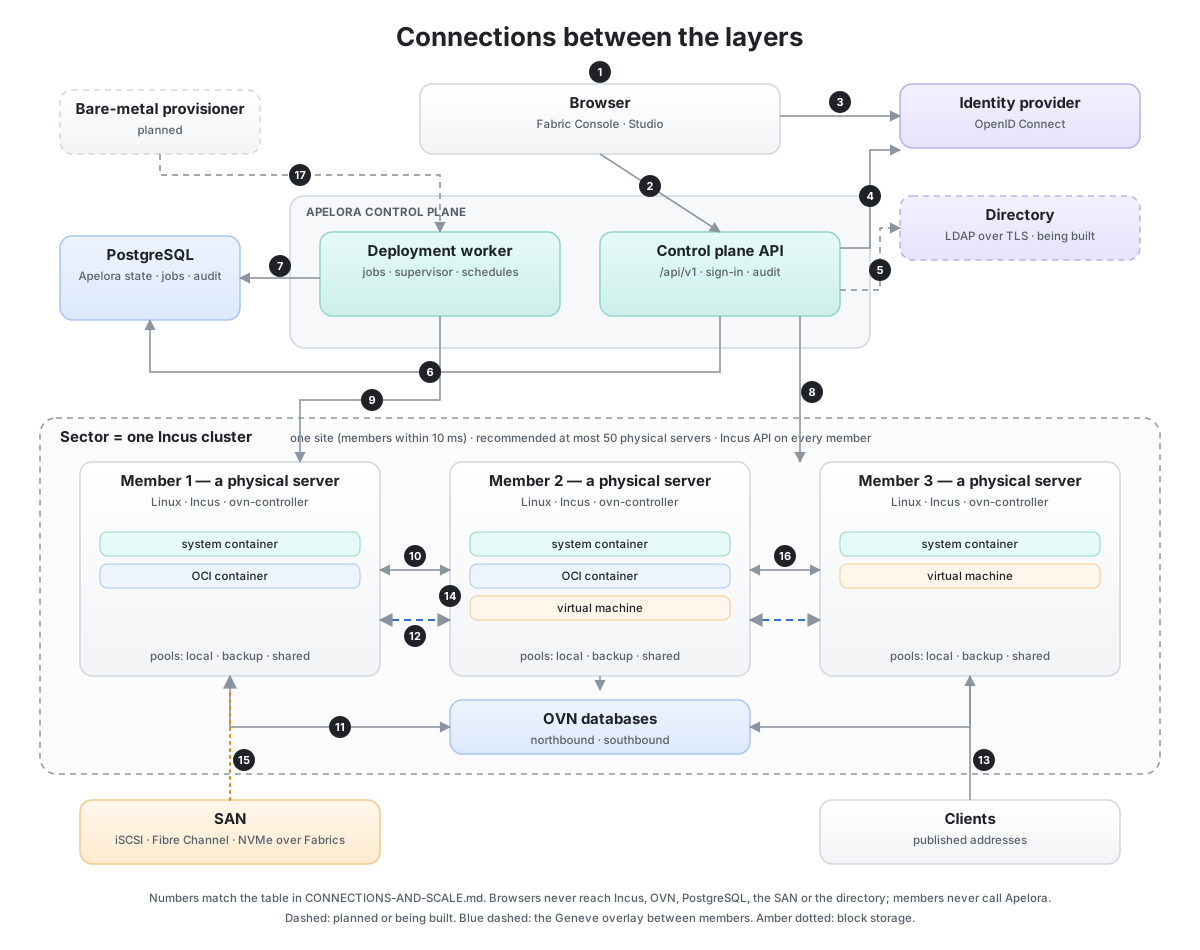
| # | From → to | Protocol and port | Authentication | Carries | When it breaks | Status |
|---|---|---|---|---|---|---|
| 1 | Browser → Console / Studio | HTTPS 443 | none (static files) | the applications, under a content security policy that allows only their own origin (infra/serve/; proven in a browser by tests/e2e/web-serving.spec.ts); nothing is loaded from elsewhere | nothing to sign in to | built |
| 2 | Browser → control plane | HTTPS 443, /api/v1 (same origin): TLS terminated by the control plane (APELORA_TLS_CERT/KEY) or by a declared proxy (APELORA_BEHIND_PROXY=1); plain HTTP only on loopback | bearer token: identity-provider access token, Apelora session (apu_), service token (aps_) or API token (apl_); public routes and refused tokens are rate-limited per client address, writes per caller (429 + Retry-After) | every read and change; terminal websockets | the UI shows the control plane as down and retries | built |
| 3 | Browser → identity provider | HTTPS 443 | the person signs in there; PKCE, state, nonce | authorization code, token exchange (cross-origin) | sign-in with that provider fails with the provider's reason; other ways in keep working | built, real-browser tested |
| 4 | Control plane → identity provider | HTTPS 443 | none (public discovery and keys) | discovery document, signing keys (cached 60 s) | that provider's tokens are refused; retried every minute | built |
| 5 | Control plane → directory | LDAPS 636, or LDAP 389 with StartTLS | binds as the person signing in | that person's entry and groups | 503 directory_unreachable; other ways in keep working | being built (ADR 0007) |
| 6 | Control plane ↔ PostgreSQL | PostgreSQL 5432 (TLS recommended) | database user | all Apelora state: designs, desired state, jobs, users, audit | 503 store_unavailable; reads that need Incus only keep working | built |
| 7 | Worker ↔ PostgreSQL | PostgreSQL 5432 | database user | job claims with leases and fencing generations, schedules, health records, the supervisor's leader lease; one extra long-lived connection per worker LISTENs on apelora_jobs | jobs wait; a claimed job's lease expires and another worker takes it; the leader lease expires and another worker supervises; a lost listener is re-established and the 2 s check covers the gap | built |
| 8 | Control plane → Incus API (per sector) | HTTPS 8443, mutual TLS | a client certificate restricted to the deploy projects; a second, unrestricted certificate only for cluster administration (join tokens, evacuation) — ADR 0003 | inventory, plans, previews, terminal sessions (websocket) | the Console says Incus is unreachable and shows the error, never stale data as current | built, REAL INCUS TESTED |
| 9 | Worker → Incus API (per sector) | HTTPS 8443, mutual TLS | the same restricted certificate | creating, starting, stopping, moving instances; volumes, snapshots, copies; waiting on operations | the job fails and is retried with backoff; nothing is assumed done | built, REAL INCUS TESTED |
| 10 | Incus member ↔ member | HTTPS 8443, mutual TLS (cluster certificate) | cluster membership | the replicated cluster database (Raft), API forwarding, instance and volume migration | a member that misses heartbeats for cluster.offline_threshold (default 20 s) is marked offline; Apelora restarts its instances on shared storage only once it is fenced (connection 22) | Incus |
| 11 | ovn-controller on each member → OVN southbound database; Incus → OVN northbound database | TCP 6642 / 6641 with TLS | OVN certificates | logical networks, ACLs, load balancers | existing flows keep forwarding; changes wait | lab (ovn.sh plaintext one database; ovn-ha.sh APPLY=1 three-member TLS, REAL INCUS TESTED 2026-10-22 including leader failover) |
| 12 | Member ↔ member overlay | Geneve, UDP 6081 | none on the wire (keep it on a private network) | traffic between instances of one application network on different members | instances on that member lose their application network | lab |
| 13 | Clients → published services | the service's port on an ingress address | the application's own | requests to an application's gateway (OVN load balancer or network forward) | the address answers from the remaining replicas | built |
| 14 | Instance ↔ instance | the module's ports on its service address | the application's own | calls between modules; ACLs allow only the connections drawn in the Studio | refused by the ACL if not drawn | built |
| 15 | Member → SAN | iSCSI 3260 (lab), or Fibre Channel / NVMe over Fabrics | the SAN's own (initiator names, CHAP) — the lab target has none | blocks of the shared pool; locks live on the LUN (sanlock), no lock server | that member's sanlock lease expires and its watchdog resets it; once its lease is DEAD, Apelora restarts its instances on shared elsewhere (ADR 0013) | lab, REAL INCUS TESTED (restart after fencing) |
| 16 | Member → member (volume copies, backups) | through Incus, connection 10 | cluster | volume copies for moves and backups to the backup pool on another member | the backup job fails and is retried | built, REAL INCUS TESTED |
| 17 | Control plane → bare-metal provisioner; provisioner → server management controllers | HTTPS; IPMI / Redfish | API key; controller credentials in the provisioner | installing and powering servers | servers are added by hand | planned (ADR 0002) |
| 20 | Collector → control plane GET /metrics; collector → worker GET /metrics | HTTPS 443 (the API address); worker HTTP on 127.0.0.1:9471 or a management address; optionally a separate control-plane listener (APELORA_METRICS_ADDR) | API: a service identity's token with fabric.metrics.read (role Metrics Reader). Listeners: none, so loopback or a management network only | Apelora's own metrics: requests, auth, jobs, supervisor, Incus calls, database pool, inventory counts (monitoring) | gaps in the collector's data; Apelora keeps working (nothing is pushed) | REAL INCUS TESTED 2026-10-23 (observe.sh, listeners on loopback) |
| 22 | Worker → each member, SSH 22 (fence probe) | SSH, host keys pinned (APELORA_FENCE_PROBE_KNOWN_HOSTS) | a key whose only authorised use is a forced, read-only command (sanlock client gets -h 1) for an unprivileged account in group sanlock (ADR 0013) | the shared volume group's lease state of every member | no fresh reading: a failed member is not fenced automatically; a person can confirm it is off | built, REAL INCUS TESTED (lab) |
| 21 | Collector → every Incus server /1.0/metrics | HTTPS on core.metrics_address (for example 8444), mutual TLS | a certificate trusted with type metrics (reads metrics only) | CPU, memory, disk, network per instance (only that server's instances); member status, warnings, operations, pool use | gaps for that server; nothing else is affected | REAL INCUS TESTED 2026-10-23 (metrics.sh) |
| 23 | Alloy → JSON log files (or journald); Grafana reads Loki | HTTP 3100 on the collector host | none (loopback) | control plane and worker log lines (APELORA_LOG_FORMAT=json), including request_id | gaps in the log UI; Apelora keeps writing locally | built (example: infra/observe) |
| 24 | Control plane and worker → Tempo POST /v1/traces | HTTP 4318 (OTLP/HTTP JSON) | none (loopback) | completed request and job spans, correlated by request_id | gaps in the trace UI; Apelora keeps working | built, off by default (APELORA_OTLP_ENDPOINT) |
The collector runs inside the installation. Metrics (connections 20 and 21) are opened by the collector. Logs are tailed from files the processes already write. Traces (connection 24) are off unless APELORA_OTLP_ENDPOINT names a receiver inside the site.
Never: browsers do not reach Incus, OVN, PostgreSQL, the SAN or the directory; instances do not reach the Incus API (no security.nesting for tenants, no API socket in instances); members do not reach Apelora (the control plane always calls in). Each sector is reached only through connections 8 and 9.
3. How far each layer scales
| Layer | Limit | Source | What happens near the limit | What Apelora does |
|---|---|---|---|---|
| Members per Incus cluster | recommended at most about 50 (roughly one rack); clusters of 100–150 servers run in practice and 250 has been tested; no hard limit | Incus maintainers (clustering, forum: cluster size, forum: largest clusters) | the cluster database's write rate (operations in flight, not running instances) and the blast radius: one control-plane fault stops the whole cluster's API | keep a sector at or under 50 members; warn above it; more servers means more sectors (ADR 0008) |
| Distance between members | network latency at most 10 ms; synchronised clocks | Incus clustering docs | Raft and heartbeats fail | one sector = one site (one data centre, or rooms within 10 ms) |
| Cluster database replicas | 3 voters + 2 stand-bys by default (cluster.max_voters, cluster.max_standby); the cluster stays up while a majority of voters is online | Incus clustering docs | — | at least 3 members per sector; spread voters across failure domains |
| OVN | one OVN deployment per sector, so at most the sector's members as chassis; OVN has run with about 700 hypervisors in one deployment | OVN architecture; 700-node report | southbound database load grows with chassis and flows | a sector is far below OVN's range; application networks do not span sectors (§5) |
| Shared volume group (sanlock) | 2,000 hosts per lockspace (host_id 1–2000 with the default 1 MiB alignment) | lvmlockd(8), sanlock | — | never the limit inside a sector; host_id = member number |
| Instances per member | hardware: hundreds of containers or tens of VMs per server, by memory | estimate | memory and disk fill | capacity views (Health page) and placement refuse what does not fit |
| Apelora control plane | stateless API apart from the items in §4; PostgreSQL holds everything | estimate: 20 sectors × 50 members × 50 instances = 50,000 instances; status polling one list per sector every 30 s ≈ 1 request/s; a few writes per deployment | PostgreSQL size and the audit log grow with use (append-only) | one primary is enough for this; partition or archive the audit log by month when it reaches tens of millions of rows |
| Deployment workers | as many as needed; jobs are claimed with FOR UPDATE SKIP LOCKED, leases and fencing | code (claim_job) | Incus operation rate per sector | run 2+ workers for availability once the supervisor has a leader (§4) |
4. Scaling issues found, and the fix for each
| Issue | Effect today | Fix | When |
|---|---|---|---|
| Sign-in settings are reloaded only in the API process that saved them | with two API processes, the other one keeps old providers until it restarts | PostgreSQL LISTEN/NOTIFY on a sign_in_settings channel; every process reloads | before running two API processes |
Terminal-session tickets, the per-address rate limits (api/rate_limit.rs: public routes, refused tokens) and the per-caller write limit live in process memory | a ticket made by one API process is unknown to another; each limit is per process, so N processes allow N times as much | sticky routing for /sessions websockets, or keep tickets in PostgreSQL; the limits stay per process × N (acceptable: divide the configured rates by N) or move to PostgreSQL | before running two API processes |
The public /health cache lives in process memory | each API process asks Incus at most every 15 s for /health (N processes: N probes per 15 s) | nothing needed at this scale | — |
| The replica supervisor runs in every worker | two workers could both restart or replace the same failed instance | a leader lease in PostgreSQL (one row, renewed every few seconds, fenced by a generation like jobs) | fixed (2026-10-21, MOCK VERIFIED with a real PostgreSQL): leader_leases, lease 15 s renewed every 5 s, every supervisor write fenced; workers are also woken by LISTEN/NOTIFY instead of only polling |
One Incus endpoint per installation (APELORA_INCUS_URL) | one sector only. The members report names that site and sector and refuses to plan a second deployment until another site is connected (MOCK VERIFIED). A second endpoint is not configured | sectors (ADR 0008): a sectors table, one adapter per sector, sector on applications and placement | the decision is in; the table and the second adapter are not |
| The audit log only grows | slower queries after years | monthly partitions; export and archive old ones | when it reaches tens of millions of rows |
5. Beyond one cluster: sectors linked into one fabric
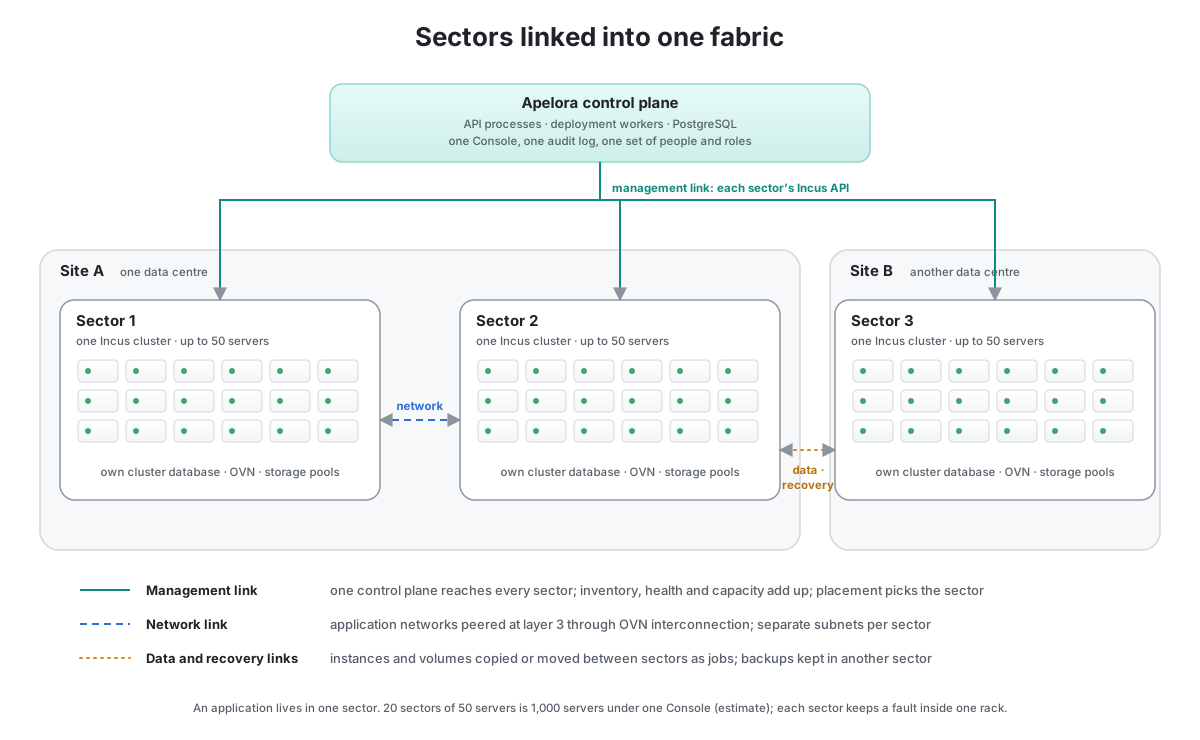
A sector is one Incus cluster: one site, at most about 50 servers, its own cluster database, its own OVN and its own storage pools. The fabric is all sectors together. Decision and details: ADR 0008. Past a few hundred servers, or across countries and continents, sectors are grouped into sites and regions, each region with its own control plane: global fabric and ADR 0009.
| Link | Connection | What it gives | Needs |
|---|---|---|---|
| Management | 8 and 9, once per sector | one Console, one audit log, one set of people and roles; inventory, health and capacity across sectors; placement chooses a sector | the sector's Incus endpoint and its restricted and administrative certificates |
| Network | 18 — OVN interconnection between the sectors' OVN deployments (TCP 6645/6646 to the interconnection databases; Geneve between gateway members) | a module in one sector calls an application in another over a peered, routed network; ACLs still allow only what was drawn | an interconnection database shared by the linked sectors, gateway members, one certificate authority for OVN, non-overlapping subnets (Apelora allocates them per sector) |
| Data | 19 — Incus migration between clusters (HTTPS 8443) | copy or move instances and volumes between sectors, as a job with a dry run | pools, networks and profiles with the same names in the target sector |
| Recovery | 19 — backup copies to another sector | redeploy a lost sector's applications elsewhere from desired state and the latest backups | a backup pool in the other sector |
- An application is placed in one sector; its replicas stay inside it (they share an application network and, for stateful modules, storage).
- For availability across sites, the same application is deployed to two sectors and published behind one address (DNS or an external load balancer); data is replicated by the application (database replication), not by Apelora.
- People see one Console: servers, health and capacity are grouped by sector; the Studio asks for a sector only when there is more than one.
Connections added by linking (to the table in §2):
| # | From → to | Protocol and port | Authentication | Carries | When it breaks | Status |
|---|---|---|---|---|---|---|
| 18 | Each sector's OVN ↔ interconnection databases; gateway member ↔ gateway member | TCP 6645/6646 with TLS; Geneve UDP 6081 | one certificate authority shared by the linked OVN deployments | routes between peered application networks | calls between sectors fail; calls inside each sector keep working | planned |
| 19 | Sector ↔ sector (Incus migration) | HTTPS 8443, mutual TLS | a short-lived trust created by Apelora for the copy, removed afterwards | instance and volume data for cross-sector moves and backups | the job fails and is retried; the source is untouched until the copy is verified | planned |
This page is a copy of docs/architecture/CONNECTIONS-AND-SCALE.md in the repository, which is the source of truth. Suggest a change.