
Deploying an application from the Studio
Status: agreed (Phase 06, slice 1 implements the backend, slice 2 the Studio panel) · Date: 2026-10-20
1. Problem and scope
A designer has a graph of modules in the Studio and wants it running on the cluster, see what will change before anything changes, and see afterwards which modules are running.
In scope: one instance per deployable module; create what is missing, keep what exists, optionally remove instances of the application that are no longer in the design; immutable revisions; live status per module. Out of scope (later phases): replicas and placement (08), networks and connections between modules (07), readiness probes beyond "Running", replacing an instance whose image changed, rollback.
Assumptions: the catalog (and so the choice of image per module) lives in TypeScript; the Studio turns each module into an InstanceSpec with instanceRequestFor. The server does not trust that choice more than any other request with the deploy permission: it validates every spec as it validates POST /api/v1/instances.
2. Design
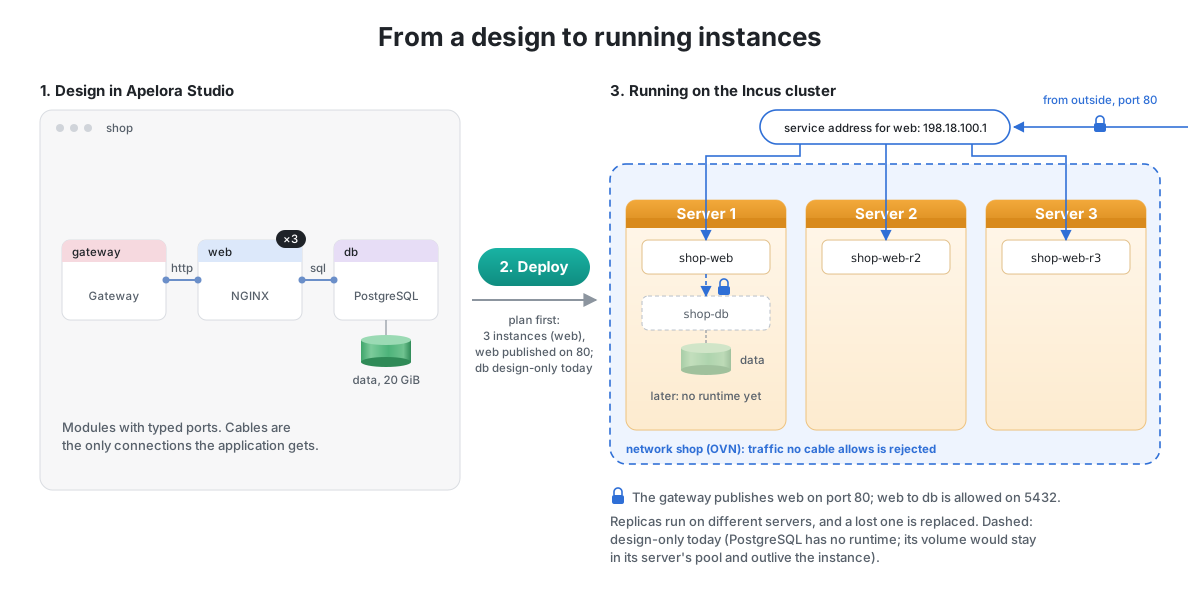
Studio ──(document + one InstanceSpec per deployable module)──▶ API
API: validate → plan (pure: desired vs observed instances) ──▶ preview
API (apply): recompute plan → refuse on conflicts → save revision → queue jobs ──▶ worker ──▶ Incus
Studio ◀── GET /applications/{name}/status (instances carrying the application's labels)- Names: a module's instance is
<application>-<module id>(e.g.commerce-stack-nginx-01), at most 63 characters, so a design maps to instances by stable ids, never by labels or order. - Ownership labels: besides
user.apelora.managed=true, Apelora writesuser.apelora.applicationanduser.apelora.module. Only Apelora setsuser.apelora.*keys. - Plan (
apelora_domain::plan), per desired module: no instance → create; an instance with the same name that carries this application's and module's labels → keep; an instance that is this module's but whose ownlimits.cpu,limits.cpu.allowanceorlimits.memorydiffer from the design → resize (the plan item lists each change; nothing else is compared in place); any other instance with that name → conflict (not Apelora's, or another application's). Instances labelled with the application but no longer in the design → remove (applied only when the caller asks for it). - Apply recomputes the plan from current inventory (the preview may be stale), refuses the whole deployment on any conflict, saves the document as an immutable revision, then queues
instance.create/instance.resize/instance.deletejobs (a resize sets the changed limits with one instance update and does not stop the instance; quotas count only its increase) (idempotency keys derived from the caller's key), auditsapplication.deploy.requested, and returns the job ids. The worker's convergence rules (ownership marker, image pins, architectures) apply unchanged. - Replicas (Phase 08): a stateless module runs 1–9 interchangeable instances (
<application>-<module>, then-r2…, labelleduser.apelora.replica); singletons and stateful modules run one. The deployment's desired state is recorded per application and project; the worker's supervisor recreates a lost stateless replica through the same job queue (never while a job for it is in flight; five-minute back-off after a failure; audited asapplication.replica.recreate) and re-syncs the network address sets. Spreading replicas is Incus's job, steered by the placement scriptletinfra/incus/placement.star(fewest replicas of the module per member, then fewest project instances); Apelora never picks a target itself. - Service addresses: with
APELORA_SERVICE_ADDRESSES, a stateless module that others connect to gets an OVN load balancer on the application network (listen address from that routed range, allocated in PostgreSQL; backends are its replicas; health checks on), so consumers use one address while replicas come and go. A replica stopped outside Apelora is restarted by the supervisor; one stopped through Apelora stays stopped. - Status lists the application's instances from the inventory with their module id, so the Studio can overlay state on the saved design without rewriting it.
3. Failure handling
| Failure | Behaviour |
|---|---|
| Name already used by something else | Plan shows a conflict; apply refuses with 409 and changes nothing |
| Inventory changes between preview and apply | Apply recomputes; the response carries the plan actually applied |
| A create job fails (image, architecture, Incus) | Job retries or fails as today; status shows the module as missing; the next deploy creates it again |
| Repeated click / network retry | Same Idempotency-Key returns the same jobs |
| Control plane restarts after queuing | Jobs are durable; the worker carries them out |
| A stateless replica disappears | The supervisor queues its recreation once; Incus places it away from its siblings |
| A stateless replica stops (crash) | The load balancer stops sending it traffic within seconds; the supervisor starts it again |
| A singleton or stateful instance disappears | Reported (worker log, status shows it missing); never recreated automatically |
4. Security
deploy permission and the project allow-list as for single instances; labels are written only by Apelora; the saved document is the caller's own design (no secrets: secret properties hold references only).
5. Next steps
Slice 1: domain types and planner, adapter labels, API (plan, deploy, status, list), tests including a real Incus run. Slice 2: Studio deploy panel (sign-in, project, plan preview, approve, follow jobs, status overlay), browser tests, real-browser check.
This page is a copy of docs/design/application-deployment.md in the repository, which is the source of truth. Suggest a change.