
Moving modules and surviving failures
Status: agreed; slices A and B built (see §3a, §3c for evidence). Slice C is Apelora's own spread, MOCK VERIFIED 2026-10-22, not run on the lab · Date: 2026-10-22 · Related: platform architecture §7, storage, storage options, member failure
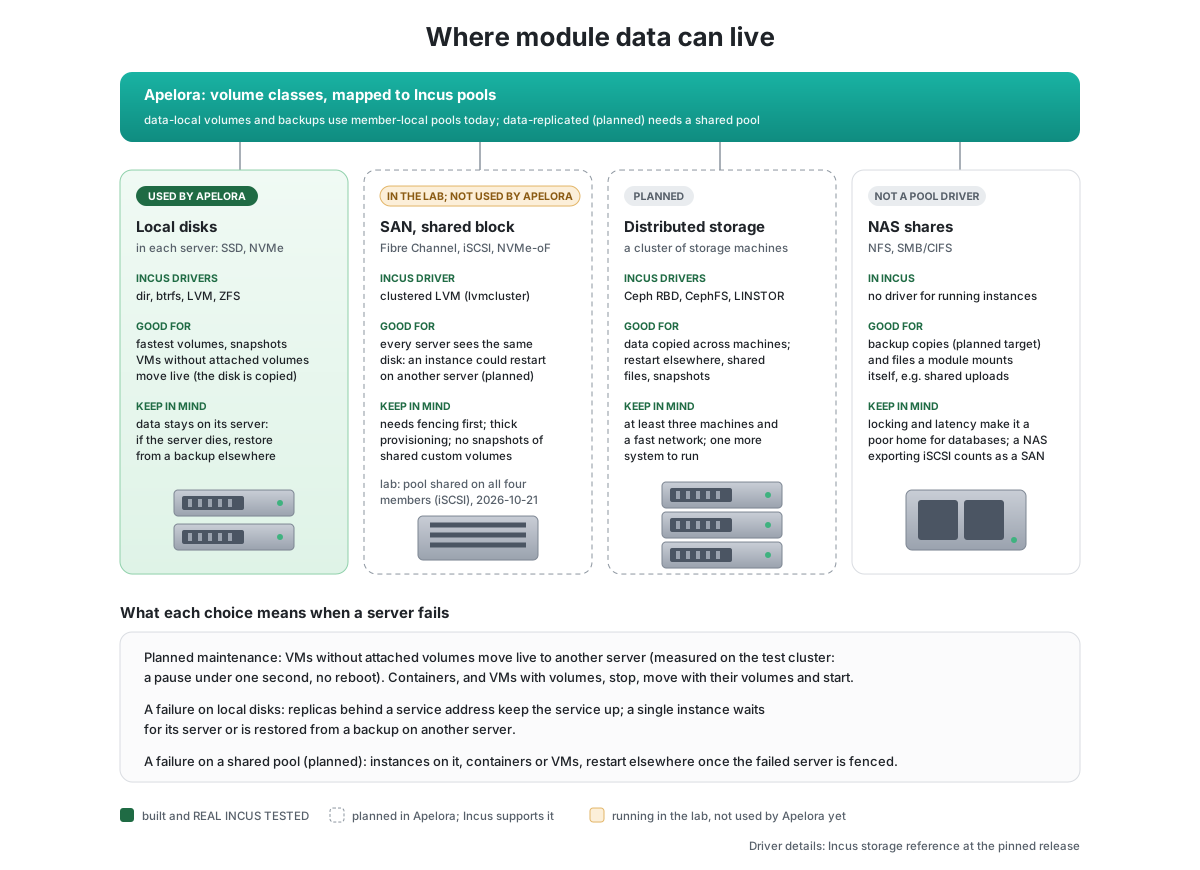
1. What Incus does, measured on the test cluster (Incus 7.0.1, four members, btrfs local pools)
| Case | Result | Evidence |
|---|---|---|
Move a running VM (migration.stateful=true) to another member | Moves running; the disk on the local pool is copied, then memory. Boot time unchanged; longest pause of a 0.1 s ticker inside: 0.80 s | REAL INCUS TESTED, 2026-10-21 |
Evacuate the VM's member with cluster.evacuate=live-migrate; restore | Moved running to another member and back; longest pause 0.29 s; no reboot | REAL INCUS TESTED, 2026-10-21 |
| Container | No live move (needs CRIU): it stops, moves and starts | Incus documentation |
| Instance with an attached custom volume on a member-local pool | The volume does not follow (unless marked dependent, which ties its life to the instance); evacuation stops the instance in place | REAL INCUS TESTED (containers), Incus documentation (VMs) |
| A member fails | Its instances stop. Incus can restart those on shared storage elsewhere (cluster.healing_threshold), and warns that it must be sure the member is really off (fencing), or two copies may write the same disk. Apelora does it per instance after fencing (§3b): a container on lvmcluster ran again on another member 144–155 s after its member's VM was force-stopped | Incus documentation; REAL INCUS TESTED, 2026-10-21 (§3c) |
| Load balancing | Incus can live-migrate VMs to the least loaded member (cluster.rebalance.*) | Incus documentation |
The restricted deploy identity may not choose a member for an instance unless the project allows it (restricted.cluster.target=allow).
2. What each workload gets
| Workload | Planned move (maintenance, rebalancing) | Unplanned failure |
|---|---|---|
| Stateless replicas behind a service address | Replace, then retire (built) | Other replicas keep serving; the lost one is replaced (built, REAL INCUS TESTED) |
| VM without local data volumes, live migration on | Moves running, under a second (slice A) | Restarts elsewhere only on shared storage, after fencing (slice B) |
Container, or VM with data-local volumes | Stop, copy the volumes to the new member, move, start: a short stop (slice A) | Waits for its member, or is restored from a backup on another member |
| Anything on a shared pool (SAN with clustered LVM, distributed storage) | Moves without copying | Restarts on another member once the failed one is fenced (slice B) |
No interruption at all through a failure needs more than one copy running: replicas for stateless modules, the application's own replication for databases.
3. Slices
A. Moves. A module can ask for live migration (VMs only; refused together with data-local volumes, which cannot follow it). Apelora then sets migration.stateful=true and cluster.evacuate=live-migrate, so evacuations move it running. A Move… action (dry run first) moves one instance to a chosen member: live when it can, otherwise only when the person allows a short stop, copying its volumes to the new member and deleting the old copies once it runs there. The move is a worker job (instance.move) so a crash resumes it; it needs restricted.cluster.target=allow on the project.
B. Failure recovery on shared storage, with fencing. Shared pools (clustered LVM on a SAN, or distributed storage) back the data-replicated class. Apelora restarts a failed server's modules from a shared pool on another server only once that server is fenced: its storage lease is dead (sanlock, read on a healthy server), or a person confirmed it is off (typed name, approval); a BMC fence provider can be added later. Incus's own healing stays off. This applies to every Apelora instance whose disks are all on a shared pool, container or VM, and to nothing on a member-local pool. Design: §3b; decision: ADR 0013.
C. Rebalancing. Apelora plans the spread. It does not turn on Incus cluster.rebalance.interval (that setting stays warned against, and at 0). For a stateless module with two or more replicas on one Online member, the plan moves one (the highest name) to the least-loaded eligible member (Online, not held, same architecture). A VM is planned live; a container stops briefly. The members report always shows the dry run. The supervisor queues at most one instance.move per pass, and only when APELORA_REBALANCE=1. REAL INCUS TESTED (four members, 2026-10-22, three runs of replicas_sharing_a_member_are_spread_by_the_rebalancer): with both container replicas on apelora-test-1, one pass queued one audited move of -r2, which was Running on apelora-test-2 3.5–3.8 s later; the next pass queued nothing. The VM (live) path of the spreader is MOCK VERIFIED; live moves themselves are tested by the move test.
3a. Slice A as built
apelora_domain::mobility::plan_movedecides live or stopped, what is copied and what blocks it (not Apelora's, the same member, not Online, another architecture, a stop not allowed).GET|POST /api/v1/instances/{project}/{name}/move(dry run; request with the name typed andallowStop), needsinstance.manage; queuesinstance.move, audited.- The worker's
instance.movejob re-reads the instance at every step: live move, or stop → copy volumes to the target member → move → start → delete the old copies and record the volumes' new member. A failed copy or move starts it again where it was. - Studio: Keep running when moved for VM modules (refused with
data-localvolumes); the request setsmigration.stateful=trueandcluster.evacuate=live-migrate. Fabric Console: Move… on Apelora's instances. - REAL INCUS TESTED (2026-10-21):
instances_move_with_their_volumes_and_vms_move_live; from the console in a real browser, a VM module moved running from member 1 to member 2 with a longest pause of 0.26 s and no reboot.
3b. Slice B: restart on another server after fencing (design)
Decision record: ADR 0013. Built 2026-10-21; evidence in §3c.
Scope. After a server fails, Apelora restarts its stateful modules whose disks are all on a shared pool on another server, once the failed server is fenced. Out of scope: planned moves (slice A), stateless replicas (substitutes, built), member-local data (waits, or a restore), Ceph-specific fencing, BMC fence providers, failback.
Who decides what.
| Concern | Owner |
|---|---|
| Member offline (heartbeats) | Incus (cluster.offline_threshold, 20 s) |
| Whether the failed server can still write | sanlock's host lease (and its watchdog), read by Apelora; or a person |
| Which instances may restart elsewhere | Apelora: deployment record, class data-replicated (root disk and volumes on the shared pool) |
| Where it restarts | Apelora names an Online member; Incus's placement scriptlet may refuse |
| Relinking and starting | Incus (POST /1.0/instances/<name>?target= with migration: true, then start) |
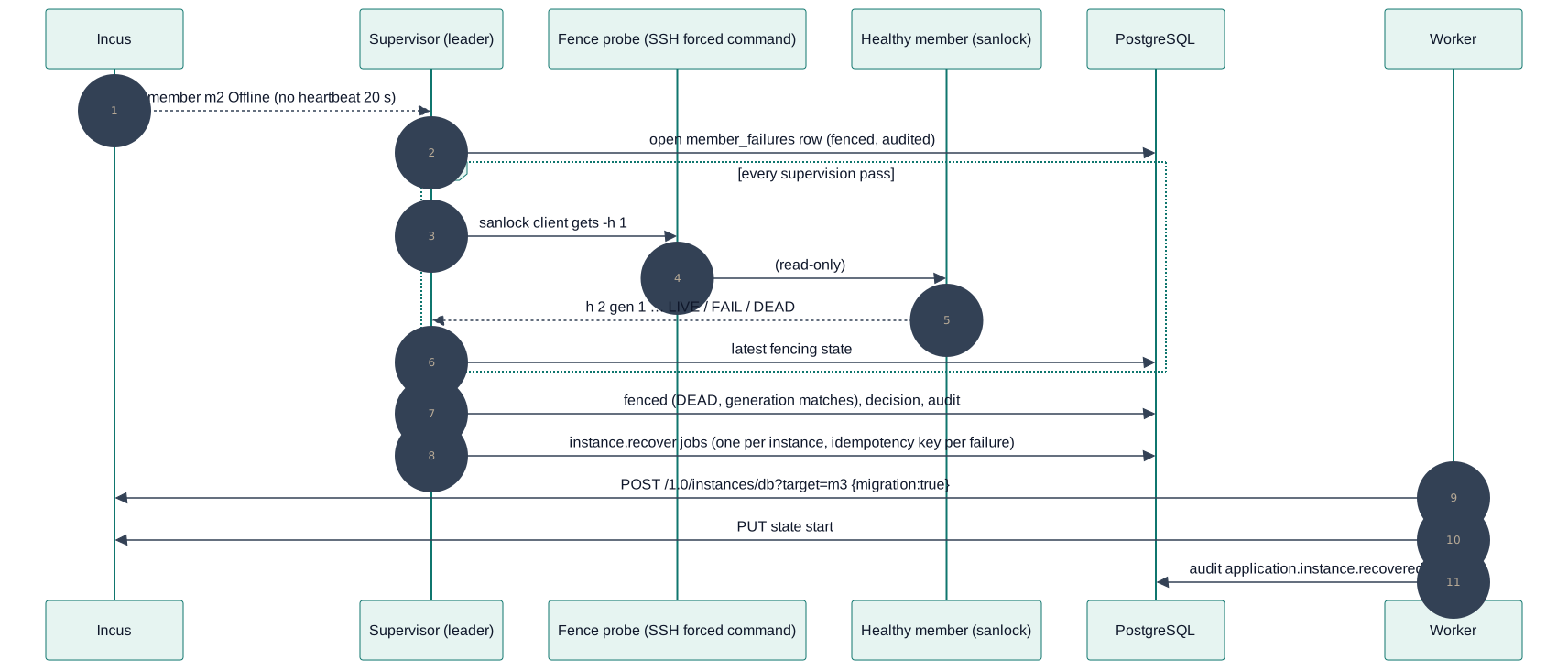
Diagram source
sequenceDiagram
  autonumber
  participant I as Incus
  participant S as Supervisor (leader)
  participant P as Fence probe (SSH forced command)
  participant H as Healthy member (sanlock)
  participant DB as PostgreSQL
  participant W as Worker
  I-->>S: member m2 Offline (no heartbeat 20 s)
  S->>DB: open member_failures row (fenced, audited)
  loop every supervision pass
    S->>P: sanlock client gets -h 1
    P->>H: (read-only)
    H-->>S: h 2 gen 1 … LIVE / FAIL / DEAD
    S->>DB: latest fencing state
  end
  S->>DB: fenced (DEAD, generation matches), decision, audit
  S->>DB: instance.recover jobs (one per instance, idempotency key per failure)
  W->>I: POST /1.0/instances/db?target=m3 {migration:true}
  W->>I: PUT state start
  W->>DB: audit application.instance.recovered
Policy. A module restarts elsewhere when every volume it has is data-replicated (at least one): the control plane resolves the class to the shared pool (APELORA_SHARED_POOL, which must exist in Incus with driver lvmcluster or ceph) and puts the module's root disk there too (InstanceSpec.rootPool, never set by a caller). A module mixing data-local and data-replicated volumes is refused. Stateless modules still cannot have volumes. Everything else on a failed server waits, and Servers → Members says why: "root disk on the member's own pool", "volume data on member-local pool local: waits for the server or a restore", "not created by Apelora".
Fencing state machine (per failure).
| State | Means | Next |
|---|---|---|
waiting | Offline, not fenced; the reason says why (lease still LIVE/FAIL; no fresh reading; lease never seen while Online; generation changed; no probe) | Lease DEAD → fenced; a person confirms → fenced; member Online → closed |
fenced | Evidence recorded (kind, who observed, host id, generation, when; or who confirmed) | Decision recorded once, jobs queued |
| closed | Member Online again (resolved_at) | Mapping re-learned; a new failure opens a new row |
Data (migration 0028). member_failures (one open row per member: detected, Incus's last heartbeat, latest fencing state, fenced at and evidence, confirmation, decided at and decision, resolved at) and member_lock_hosts (member → lockspace, host id, generation, seen at; learned from each member's own lockspace line while it is Online).
Contracts. GET /api/v1/cluster/recovery (cluster.view): per failed member its fencing state, reason and next step, and per instance whether it restarts (and on which member) or waits (and why). POST /api/v1/cluster/members/{member}/fencing (cluster.fence_confirm, approval, typed name): a person confirms the server is off; refused unless Incus reports it Offline. Job instance.recover ({project, name, application, module, failedMember, failure}).
The job, step by step (each step re-reads Incus, so a reclaimed or retried job continues):
- Instance gone → rejected. On another Online member and running → done.
- Still on the failed member: the failure must still be open and fenced, and the member still Offline (else rejected: nothing changes). Safe point (a cancellation stops here, nothing changed). Choose the member (§ ADR decision 5), relink (recorded Incus operation).
- On the new member, stopped: ownership marker checked (
user.apelora.managed, readable again), start (recorded operation). - Running there: audit
application.instance.recoveredwith the failure, the evidence kind and the seconds since the failure was detected.
Failure handling.
| Failure | Behaviour |
|---|---|
| Probe unreachable, refused or slow (10 s) | No fresh reading: waiting; counted in apelora_fence_probes{outcome="failed"} |
| The failed server is partitioned but reaches the SAN | Lease stays LIVE: waiting forever; alert member-unfenced after 5 min; a person decides |
| Failed server returns before fencing | Row closed; nothing was changed |
| Failed server returns after relinking | Its instance records now point elsewhere; Incus does not start them there. The lockspace is rejoined at boot |
| Relink refused (scriptlet, target offline) | Attempt fails, retried with back-off; the next attempt chooses again |
| Start refused (lock still held: this member's sanlock does not see the host dead yet) | The job waits (5 s steps, no attempt used) for up to 120 s after fencing, then fails and is retried; data cannot be written twice |
| Worker dies mid-job | Lease expires, another worker resumes from the observed state |
| Supervisor leader changes | The decision is in the row; jobs have idempotency keys: no second decision |
Observability. Logs recovery: … (member, failure, evidence, instance). Metrics apelora_member_failures{state}, apelora_fence_probes{outcome}, apelora_recoveries{outcome}. Alert member-unfenced ("A failed server is waiting for fencing", 300 s). Audit cluster.member.failed, cluster.member.fenced, cluster.member.fence.confirmed, application.instance.recover, application.instance.recovered.
Security. The probe key can only run one read-only command as an unprivileged account; host keys are pinned; nothing secret is stored in the database or logged. Confirmation is a protected action (approval). The worker still uses only the restricted deploy identity (restricted.cluster.target=allow lets it name the member).
3c. Slice B as built (2026-10-21)
- Domain:
apelora_domain::fencing(sanlock output parser,learn,decide, Incus heartbeat time),apelora_domain::recovery(plan_recovery,choose_target,blocked_by_storage),storage::VolumeClass::DataReplicated,InstanceSpec.rootPool. - Persistence:
member_failures,member_lock_hosts(migration 0028),apelora_persistence::recovery. - Worker:
fencing.rs(SSH probe),recovery.rs(supervisor step and theinstance.recoverjob), metrics, alert rulemember-unfenced. - API:
GET /api/v1/cluster/recovery,POST /api/v1/cluster/members/{member}/fencing(cluster.fence_confirm, approval); the control plane resolvesdata-replicatedtoAPELORA_SHARED_POOL; the Health page's Incus row says whether each failed server is fenced. - Console: Servers → Members, Failed servers: fencing state, the reason or the evidence, per instance Restarts on … or Waits for its server with why, Confirm powered off… (typed name).
- Evidence: MOCK VERIFIED (worker, API, Console with a stubbed API and axe); REAL INCUS TESTED:
shared_pool_instances_keep_their_disks_on_it_and_move_without_copying, three containerha-drill.shruns and three VM runs (HA_DRILL_VM=1, 2026-10-23; timeline in the runbook). Not drilled: a partitioned (not stopped) member, and the confirmation path against the lab. - Open: the Studio cannot choose
data-replicatedyet (the API accepts it); a BMC fence provider; Ceph-specific evidence; fencing as soon as any healthy observer (whose own lease is LIVE) reports DEAD, instead of the freshest reading only (run 3 fenced 9 s after member 1 saw DEAD).
4. Failure handling of a move
| Failure during a move | Behaviour |
|---|---|
| The copy of a volume fails | The instance is started again where it was; the partial copy is deleted |
| The instance move fails | The old volumes are still there; the instance is started where it was |
| The worker stops half way | The job is resumed: it reads where the instance and the volumes are, and continues |
| The instance does not start on the new member | The old volumes are kept; the job fails and says so; the runbook moves it back |
Old volumes are deleted only after the instance runs on the new member.
This page is a copy of docs/design/mobility-and-ha.md in the repository, which is the source of truth. Suggest a change.