
Apelora platform architecture (target)
Status: target design — describes where we are going. Much of it now runs on a disposable test cluster. Date: 2026-10-20, runtime and layer mapping corrected 2026-10-21. Decisions: ADR 0001 Incus-first (accepted), ADR 0002 MAAS (proposed). Plan: implementation phases. Today's state: current-state audit.
1. Goal
A user composes an application from small modules in Apelora Studio, connects typed terminals, chooses resources, replicas and exposure, reviews a deployment plan and deploys it onto a cluster of Linux servers. Administrators run the servers, networks, storage, tenants and failures in Apelora Fabric Console. Apelora adds the application layer; it does not re-implement cluster management, packet forwarding or hardware provisioning.
2. Three management levels, one authority each
| Level | Authority | Responsibility |
|---|---|---|
| Application | Apelora (Rust control plane + PostgreSQL) | Module classes, application graphs, desired state, connectivity intents, service names, publishing, replicas, health, mobility, recovery policy, audit |
| Compute | Incus cluster | Membership, quorum (Raft-replicated database), instance placement and lifecycle, projects, profiles, images, storage and network objects, evacuation |
| Network dataplane | OVN, managed through Incus (one network per application, built), over the physical network that carries the uplink | Forwarding, logical networks, ACL enforcement, load balancing |
| Bare metal (proposed) | MAAS | Discovery, network boot, commissioning, OS install, power control |
Rules: one owner per piece of state; Apelora observes the others and acts only through their APIs; nothing writes another system's database.
3. Layers
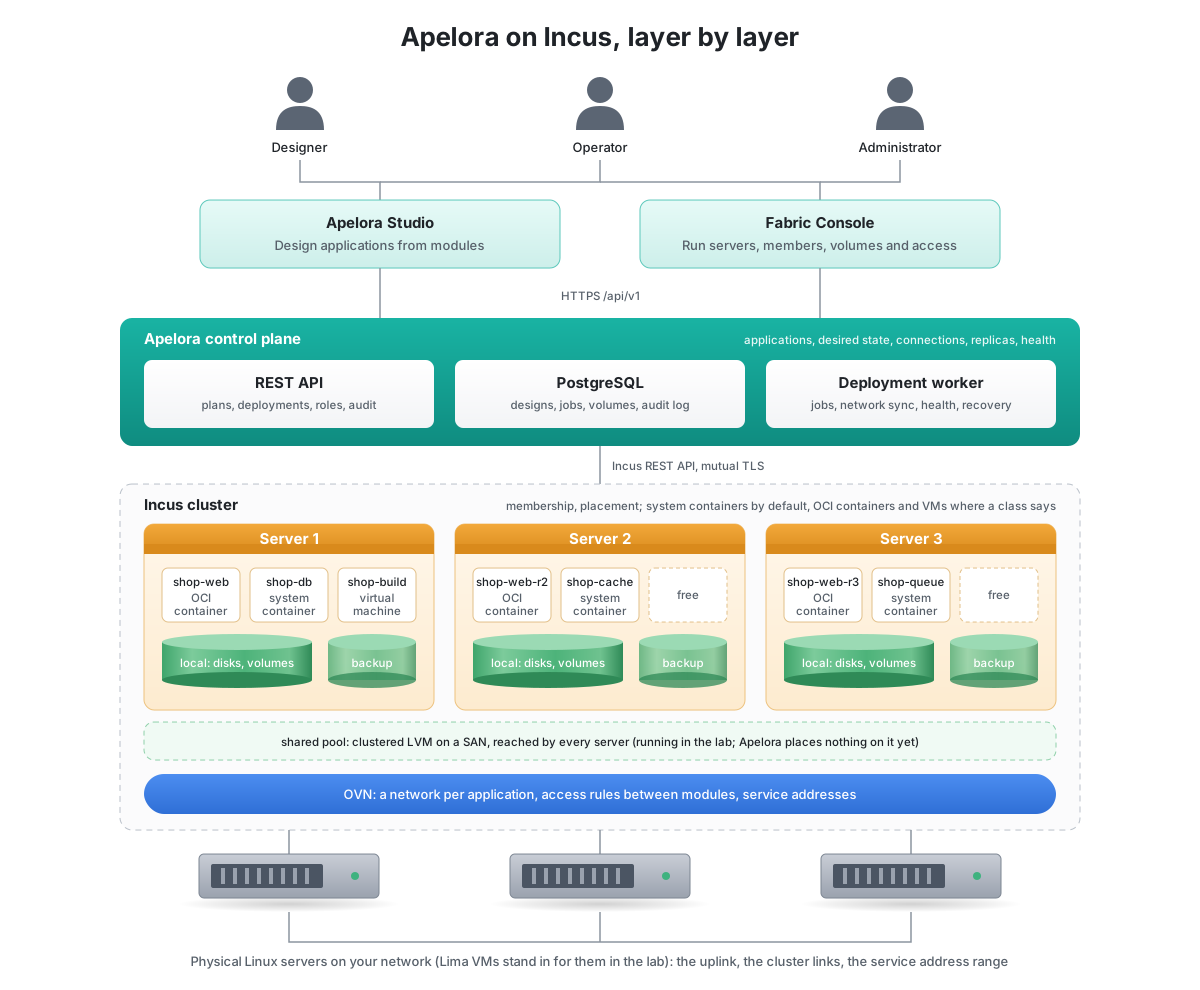
 LAYER 1  USER INTERFACES (React + TypeScript, independent builds)
 +------------------------------+  +------------------------------+
 | apps/fabric-console          |  | apps/studio                  |
 | servers, members, instances, |  | catalog, React Flow graph,   |
 | networks, storage, tenants,  |  | typed terminals, replicas,   |
 | operations, health, RBAC     |  | exposure, plan, live status  |
 +--------------+---------------+  +---------------+--------------+
                +---------------+------------------+
                                | HTTPS /api/v1 (OpenAPI)
                                v
 LAYER 2  APELORA CONTROL PLANE (Rust)
 +------------------------------------------------------------------+
 | services/control-plane   Axum API, authn/RBAC, catalog, graphs,  |
 |                          validation, plans, operations, audit    |
 | services/deployment-worker  reconciler, jobs, health, recovery   |
 |   libraries: domain, persistence, auth, orchestration,           |
 |   network-fabric, service-discovery, coordination, placement,    |
 |   health, mobility, recovery, storage-policy,                    |
 |   incus-adapter, (maas-adapter, node-enrollment)                 |
 +------------------------+-------------------------+---------------+
                          |                         |
              PostgreSQL (Apelora state)      Incus REST API (mTLS)
                                                    |
 LAYER 3  INCUS CLUSTER  (Raft DB, members, placement, instances)
 +------------------+   +------------------+   +------------------+
 | member 1         |   | member 2         |   | member 3         |
 | Linux + Incus    |   | Linux + Incus    |   | Linux + Incus    |
 | shop-web shop-db |   | shop-web-r2      |   | shop-web-r3      |
 +------------------+   +------------------+   +------------------+
      \____ one OVN network per application: ACLs, service addresses ____/
 LAYER 4  INFRASTRUCTURE: physical servers, switches, the uplink network;
          storage pools (local per member, backup; shared on a SAN, unused yet),
          service address range, DNS, PKI, metrics
The network fabric, coordination and HA engines are libraries inside the two Rust services, not separate products. In Apelora a server is an Incus cluster member, called a server (or member) in the UI; there is no extra Apelora host agent unless an ADR introduces one.
4. Modules and runtimes
A module class says how it runs in runtime.kind (packages/assembly-model/src/schema.ts; turned into an Incus request by instanceRequestFor in runtime.ts). A class without a runtime is design-only.
Runtime (runtime.kind) | Incus instance | Use | Catalog classes today |
|---|---|---|---|
incus-system-container | LXC system container | The default: web servers, APIs, workers, caches, databases | Debian |
incus-oci-container | OCI application container | Where the class ships as a single-process image, pinned by digest | NGINX |
incus-vm | QEMU virtual machine | Only where needed: another kernel or operating system (Windows, guestOs), kernel modules, firewall-style modules, or live migration (migration.stateful) | Linux base (a VM so it can move while running) |
A component (a class with composition) is not a runtime: it is a Studio grouping whose parts are deployed in a later version; today it stays in the design. A Studio node is a logical module; its replicas are separate Incus instances mapped by stable ids. Saved graphs never contain host names or IP addresses.
4.1 From an application to running instances
The whole chain in one place; other documents link here.
| Step | What it is | Names and example | Decided by |
|---|---|---|---|
| Application | A design deployed under a name, into one Incus project | shop (from the design's name) in project apelora | The person deploying |
| Module | A node on the canvas: one use of a module class (ModuleInstance in the model, not an Incus instance) | web, class NGINX | The design |
| Replicas | Stateless classes only (availability: stateless): 1–9 interchangeable instances. Singleton and stateful classes run one | shop-web, shop-web-r2, shop-web-r3; a stand-in made while a replica's member is down gets -s1 (shop-web-r2-s1) | The design, within the class's availability (replicasOf) |
| Instance kind | From the class's runtime, never from availability: system container by default, OCI application container or VM where the class says | NGINX → OCI container; Debian → system container; Linux base → VM | The module class |
| Member | The server Incus places the instance on: a physical server in production, a Lima VM standing in for one in the lab. Apelora's placement scriptlet (infra/incus/placement.star) keeps replicas of a module apart | apelora-test-1 … -4 in the lab | Incus, steered by the scriptlet; a person for a planned move (instance.move) |
| Storage | Root disk from the project's default profile on local. Each volume is <instance>-<volume> on the pool in APELORA_VOLUME_POOL (local, btrfs in the lab), on the instance's member, attached as vol-<volume>. Backups are copies in backup (dir), on another member where there is one. shared (clustered LVM on a SAN) exists in the lab, but Apelora places nothing on it yet | shop-db-data | The class or the design (volume name, size, path); the administrator (pools) |
| Network | One OVN network per application with one ACL and one address set per module; each drawn connection becomes an allow rule; a stateless module others connect to, or a published one, gets a service address (OVN load balancer); a published port is open from outside. A bridge (incusbr0) is only the lab's uplink | Consumers read APELORA_SERVICE_WEB | The design's cables, link tags and gateway; the worker's network.sync |
Replica count comes from availability, not from the instance kind: a VM class marked stateless could have replicas; a system container class marked singleton cannot. Details: application deployment, service discovery, storage, moving modules.
5. Virtual network fabric
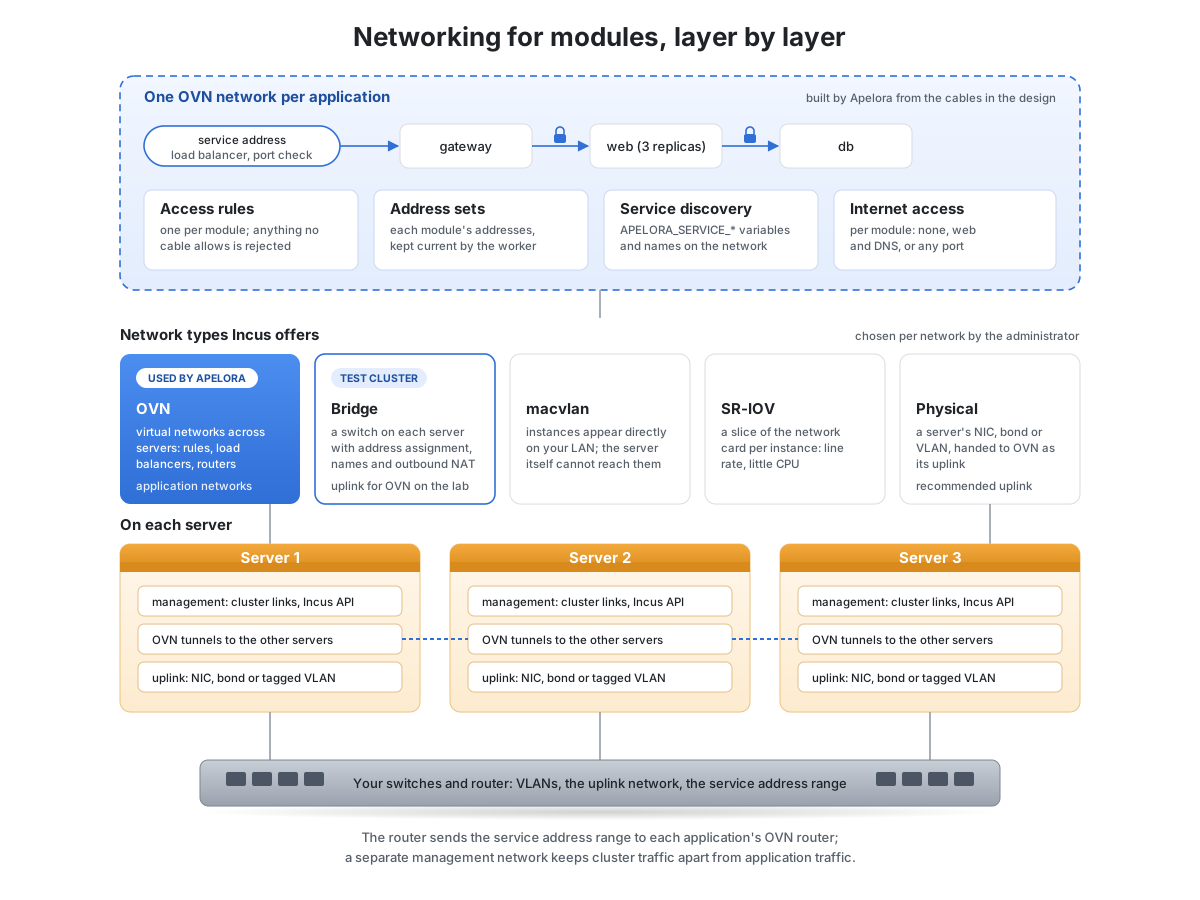
A connection is a service dependency plus an authorisation, compiled into network intents:
Studio:   web.api ──http──> backend.http
Intent:   source=web target=backend proto=tcp port=8080 access=allow
          discovery=backend.<app>.internal
Apply:    resolve backend replicas → ensure endpoint → apply ACLs →
          configure consumer → check connectivity/readiness
Runtime: web-01, web-02 ──> backend.<app>.internal:8080 ──> api-01, api-02| Studio element | Becomes |
|---|---|
| Module | Incus instance(s), one per replica (§4.1) |
| Input terminal | Service endpoint |
| Output terminal | Dependency |
| Connection | Allowed traffic + name resolution |
| Public terminal | Ingress endpoint |
| Volume connection | Persistent volume attachment |
- Stable service names (Apelora-managed) map to healthy replicas, so replacing or moving an instance never breaks consumers.
- Deterministic compile → diff → apply, deny by default, scoped by Incus project.
- One OVN network per application (built, REAL INCUS TESTED): Incus-managed OVN with an ACL and an address set per module, health-checked load balancers for service addresses, and egress to
@externalfor internet access. OVN runs its own services and needs an uplink network that spans the members; in the lab a bridge (incusbr0) plays that uplink. DNS zones and forwards are not used yet.
Publishing applications
| Exposure | Reachable by | Use |
|---|---|---|
| Internal service name | Connected modules | Front end → API |
| Private address | Authorised internal networks | API, databases, caches |
| Shared public HTTPS (default) | Internet, via domain + TLS on shared ingress | Most web apps |
| Dedicated public address | Internet, own address | Special TCP services |
| Private VPN endpoint | VPN users | Internal business apps |
Ingress is a layer-7 proxy for domains and TLS in front of health-checked backends (OVN load balancers or the proxy's own checks). Several replicas behind a single unreplicated ingress is not HA.
Address authority: provisioning/host addresses — MAAS or site IPAM; container addresses — Incus/OVN; service endpoints — Apelora ingress controller; public addresses — router/provider pool; DNS names — Apelora's DNS integration. Apelora displays all of them and allocates none it does not own.
6. Coordination
| Responsibility | Owner | Mechanism |
|---|---|---|
| Cluster membership, leader, instance state | Incus | Its Raft-replicated database |
| Network forwarding state | OVN | Its own databases |
| Deployments, replicas, operations, leases | Apelora | PostgreSQL |
| Health and readiness decisions | Apelora | Health controller |
| Storage ownership | Storage system + policy | Backend + fencing |
- API instances are stateless; the operation queue, leases and generations live in PostgreSQL. Workers claim work with row locks (
FOR UPDATE SKIP LOCKED) or expiring leases; one reconciliation flow per application at a time; a generation number stops a stale worker from committing old decisions; a recovering worker reads actual Incus state before retrying. - Locks alone do not prevent split-brain against external APIs: also idempotency keys, Incus operation ids, ownership checks, fencing.
- Control-plane HA needs a redundant entrypoint and a tested PostgreSQL failover plan. MVP: one primary with tested backups. No separate consensus service until a measured need.
- MAAS and the control plane run on management infrastructure that survives the loss of the compute cluster.
7. Health, HA and mobility
Separate detectors, each with source, timestamp and freshness: member (Incus heartbeat/quorum), instance (Incus state), service (readiness/liveness probes), ingress, storage. Running ≠ ready ≠ available ≠ recoverable.
| Workload | Default replicas | Recovery |
|---|---|---|
| Stateless HTTP / API | 2+ on different eligible members | Health-gated routing; replace failed replicas |
| Worker | By queue semantics | Restart/replace; idempotent jobs |
| Cache | 1 unless replicated by design | Recreate |
| Database (single writer) | 1 | Blocked on ambiguous failure until fencing + storage ownership proven; operator decides |
| Replicated database | By design | Application-specific failover adapter |
Replicas follow the class's availability, not its instance kind: a VM is not limited to one, and a container is not stateless by default. A VM with live migration on moves running in planned moves (instance.move, evacuation); after a member failure, only instances on shared storage can restart elsewhere, after fencing (moving modules, slice B, built; ADR 0013).
Relocating stateless modules (replace, then retire): plan (policy + capacity) → start replacement on another member → wait for readiness → switch the service name's routing → drain and retire the old instance. No container live migration is needed; downtime depends on replica count, draining, sessions and ingress, and is measured, not promised.
Stateful single instances: planned stop-and-move with storage checks and an announced interruption. Ordinary LXC live migration is limited and is never assumed.
Policy-aware evacuation (Mobility & HA engine): discover workloads on a member → classify (stateless, replicated, singleton, stateful) → check capacity, anti-affinity and minimum-healthy rules → dry-run plan with a reason for every blocked item → stop new placements → drain → relocate one by one with verification → maintenance only when all checks pass → controlled restore (Incus can restore a member without moving instances back). It refuses to remove the last healthy instance of a service whose policy requires continuous service.
Two recovery modes, mutually exclusive per workload: native Incus healing (Apelora observes) or Apelora-managed recovery (Apelora coordinates fencing and replacement). Never both. Incus healing (cluster.healing_threshold) stays at its default (disabled) unless an operator enables it deliberately.
Placement: Incus places instances (by default favouring members with fewer instances). Apelora adds replica anti-affinity and failure domains through Incus cluster groups, targets and placement scriptlets once verified — never a competing scheduler.
Milestones: M1 intelligent evacuation (plan, dry run, drain, move, verify, restore); M2 replica-aware recovery; M3 advanced HA (tested fencing, stateful recovery, shared storage, automatic policies).
8. Storage
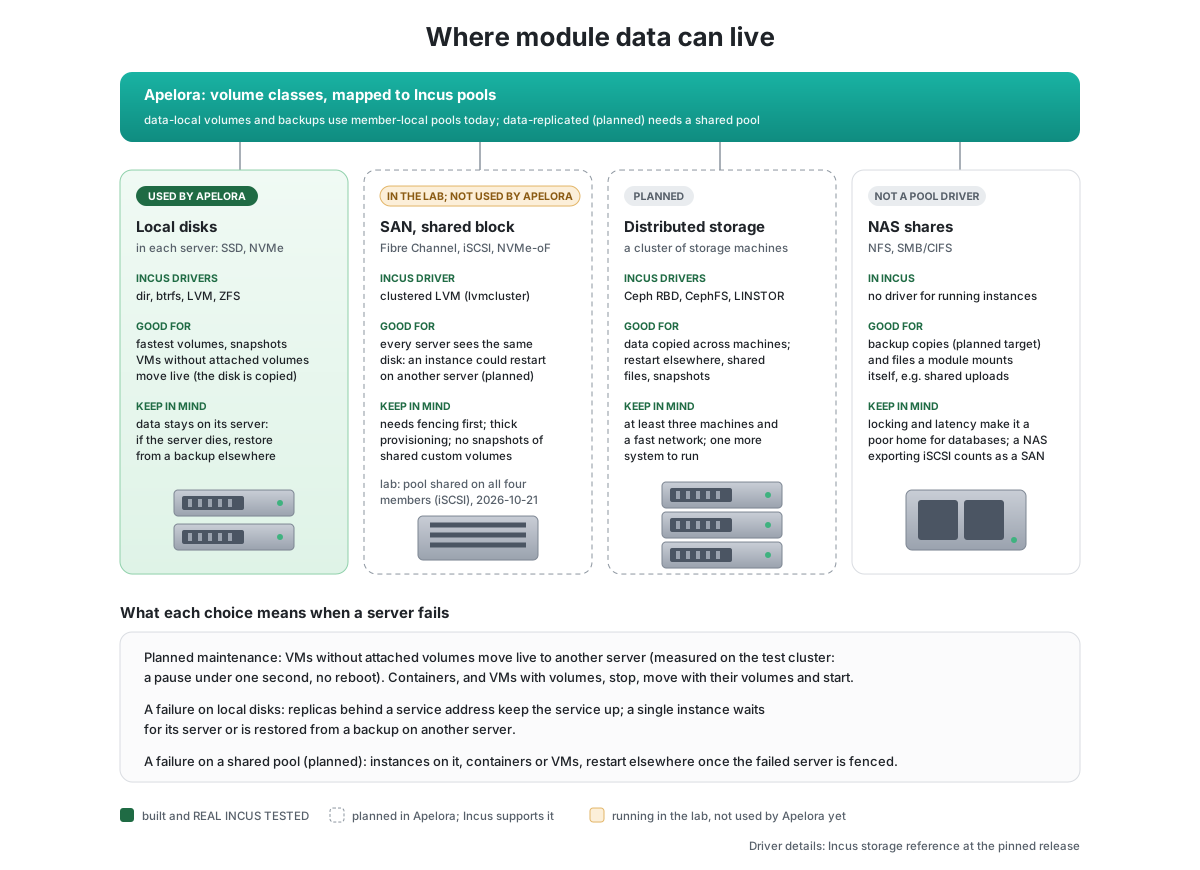
Details — how Incus models pools and volumes, local versus shared storage, the volume-class abstraction and its lifecycle — are in storage.
- Today: a local pool on each member (btrfs
localin the lab) for root disks anddata-localvolumes; snapshots, scheduled snapshots and backups copied to abackuppool on another member; no cross-member stateful recovery promises. - HA: a shared pool that every member reaches, operated deliberately with its own monitoring: clustered LVM (
lvmcluster) on a SAN, or distributed storage that Incus supports (e.g. Ceph RBD, LINSTOR). The lab has asharedlvmcluster pool on an iSCSI LUN (created 2026-10-21, REAL INCUS TESTED on all four members); Apelora does not place anything on it yet. These are external systems that Incus talks to; Apelora does not link or vendor them (Ceph is mainly LGPL), so their licences do not affect our code. - Volume classes: ephemeral root, persistent exclusive, shared read-only, backup, secret — each with ownership, relocation policy and RPO/RTO. Snapshots are not backups; restores are tested.
9. Bare metal (proposed, ADR 0002)
New server → network boot → MAAS commissioning (CPU, RAM, disks, NICs, BMC) → "new server found" in Fabric → administrator approval → OS install + cloud-init → preflight → single-use Incus join token → validation → eligible for placement. Power on/off/reboot through MAAS; powering off a member with workloads first proposes an evacuation; emergency power-off is separately permissioned. Networks: provisioning, management, storage and BMC separated (VLANs or equivalent); MAAS DHCP never on a network that already has one without coordination.
10. Security and tenancy
Details — roles, scopes, the request path and best practice for every layer — are in access and roles and ADR 0005 (proposed).
- Roles: Fabric admin, operator, Studio designer, auditor; every endpoint authorised server-side and scoped by project. Designers cannot change physical infrastructure.
- Incus over mTLS with server verification on a management network; client certificates and BMC credentials only in the backend's secret store — never in the browser, logs or repository.
- Restricted Incus projects, unprivileged containers, no nesting/raw config/host mounts/devices for tenants; image provenance by digest.
- Destructive or risky actions (delete, member removal, storage/network changes, enabling healing, power-off) need confirmation and are audited.
10a. Applications as a first-class object
The Studio opens on an Applications view (list, create, open a canvas) backed by server-side drafts; see applications view.
11. Upstream
Incus and (if adopted) MAAS are installed as system packages and tracked in upstream.lock.yaml: URL, licence, intended release, verified version/commit, required API extensions, tested host compatibility, verification date. Update checks open reviewable pull requests; nothing upgrades production automatically. An optional read-only source checkout (git-ignored) is for reading only and is never compiled into Apelora.
Contributing back to Incus follows its own rules: contributions must be Apache-2.0 compatible (none of our AGPL code), carry a human author's DCO sign-off and must not credit AI tools; Incus also asks that AI tooling not run on machines holding its repository credentials.
12. Non-goals (for now)
A container orchestrator; writing a hypervisor, cluster manager, scheduler, storage engine or distributed filesystem; container live-migration claims; automatic split-brain-prone stateful failover; arbitrary privileged host commands from users; unattended upstream upgrades; a separate consensus service.
13. Repository layout
apps/            studio, fabric-console
packages/        assembly-model, module-catalog, api-client (generated from the API's OpenAPI document)
services/        control-plane (Axum API), deployment-worker (jobs, network sync, replica supervisor)
crates/          domain, persistence, incus-adapter, auth, identity; further crates are
                 created by the phase that needs them
infra/           dev/ (local PostgreSQL and identity provider), identity/, incus/ (placement scriptlet)
scripts/         test-cluster/ (disposable lab), enrol/, upstream/, ci/, security/, licenses/
docs/            adr/, architecture/, design/, development/, runbooks/, guides/, assets/
.agents/skills/  shared agent skills (Claude via .claude/skills symlinks, Codex natively)
This page is a copy of docs/architecture/PLATFORM-ARCHITECTURE.md in the repository, which is the source of truth. Suggest a change.