
Tenancy isolation and quotas
Status: built (first slice); evidence per part in §7 · Date: 2026-10-21 · Decision: ADR 0012 · Related: ADR 0003 (two Incus identities), ADR 0005 (one restricted Incus project per environment), identity and authorization, cloud roadmap principle 4, Console plan (Tenancy, P1), runbook
1. Problem and scope
Apelora already models organisations → projects → environments, and every environment names the Incus project it deploys into (<organisation>-<project>-<environment>, derived by apelora_auth::backend::incus_project_name). But nothing created that Incus project: an administrator had to make it by hand, restrict it, and add it to the deploy identity's project list. There were no quotas, so one team could take the whole cluster.
Goals
- A restricted Incus project per environment, created by Apelora (or adopted when it already exists), with the documented
restricted.*keys, its owndefaultprofile, and the deploy identity allowed to use it. - Quotas on organisations, projects and environments: instances, CPUs, memory and disk. Stored in Apelora, checked when a deployment is planned (a clear refusal before anything is queued), and mirrored to Incus project limits so Incus enforces the per-environment ceiling too.
- API and Console: set and view quotas; a Tenancy page under Identity & Access with each environment's Incus project, its restrictions and limit use; plan previews show quota use.
Non-goals (this slice)
- Deleting or renaming environments (P2): the Incus project stays when Apelora stops using it.
- Metering and billing (roadmap step 2).
- Quotas on networks, processes, snapshots or per-pool disk (
limits.networks,limits.processes,limits.disk.pool.*). The four dimensions are what plans can predict. - Blocking nested virtualisation for VMs (
restricted.virtual-machines.nesting=blockrequires every VM to setsecurity.nesting=false; not tried on the lab yet, see §8).
Scale. Tens of organisations, hundreds of environments per sector. A quota check reads one Incus project state per environment under the scope (GET /1.0/projects/<name>/state, a few milliseconds each), only when a quota applies.
2. Mapping onto Incus
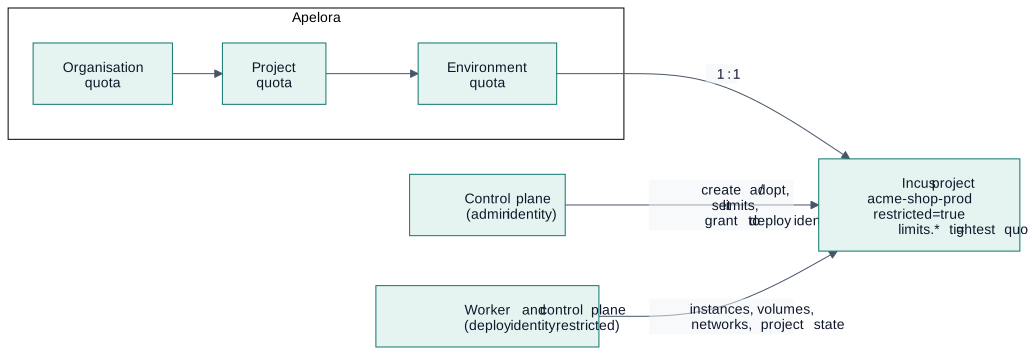
Diagram source
flowchart LR
  subgraph Apelora
    O["Organisation<br/>quota"] --> P["Project<br/>quota"] --> E["Environment<br/>quota"]
  end
  E -- "1 : 1" --> IP["Incus project<br/>acme-shop-prod<br/>restricted=true<br/>limits.* = tightest quota"]
  CP["Control plane<br/>(admin identity)"] -- "create / adopt,<br/>set limits,<br/>grant to deploy identity" --> IP
W["Worker and control plane<br/>(deploy identity, restricted)"] -- "instances, volumes,<br/>networks, project state" --> IP- One environment, one Incus project, named deterministically (unchanged):
<org>-<project>-<env>, lowercase, at most 63 characters; tenants cannot choose it; platform administrators (cluster.manage) may map an existing project instead. Names inAPELORA_DEPLOY_PROJECTSanddefaultare reserved. - Who does what (ADR 0003 extended by ADR 0012): Incus refuses a restricted certificate every server-level and project-editing call (
internal/server/auth/driver_tls.go:ObjectTypeServerbeyond view,can_editon a project, certificates beyond view). So creating a project, changing its configuration and profile, and adding it to the deploy identity's project list are done by the admin identity, in the control plane only, synchronously (like join tokens). The worker never gets the admin identity. Reading a project, its state and deploying into it stay with the restricted deploy identity. - States of an environment's Incus project (
environments.incus_state):pending— not prepared by Apelora yet (created before this feature, no admin identity configured, or the last attempt failed;incus_detailsays why);created— Apelora created it with the baseline below;adopted— it existed; Apelora checkedrestricted=true, granted it and leaves its restrictions as they are (it reports differences from the baseline). An existing project that is not restricted is never adopted: the environment stayspendingwith that reason. An existing project is adopted only when a platform administrator (cluster.manage) named it when creating the environment (incusProject; recorded asenvironments.incus_project_chosen, migration 0032). A project whose name merely matches the name derived from the environment's identifiers, and a project that carries another environment'suser.apelora.environment, are never adopted: creating the environment answers409 incus_project_existsand creates nothing, and preparing an existing environment answers the same and leaves itpendingwith the reason (audited as denied). Environments adopted before this rule, and ones a platform administrator mapped, keep their project.
- Instance settings a caller may send are an allow-list in Apelora itself (
InstanceSpec::validate_from_caller):limits.cpu,limits.cpu.allowance,limits.memory,migration.stateful,cluster.evacuate,environment.<NAME>anduser.<key>. Keys that let an instance reach its host (security.*,raw.*,linux.*, kernel limits) are refused before Incus sees them, so a project that was left unrestricted (preflight only warns) does not turn deploy rights into host rights.
2.1 Baseline configuration of a created project
Every key is from the pinned Incus release's documentation (doc/config_options.txt, groups project-features, project-restricted, project-limits, project-specific) and was checked against internal/server/project/permissions.go:
| Key | Value | Why |
|---|---|---|
restricted | true | turns the restrictions on |
restricted.containers.nesting | block | no nested Incus |
restricted.containers.privilege | unprivileged | no privileged containers |
restricted.containers.lowlevel | block | no raw.* and similar |
restricted.containers.interception | block | no system call interception |
restricted.virtual-machines.lowlevel | block | no raw QEMU options |
restricted.devices.disk | managed | only pool-backed disks (Apelora's volumes); no host paths |
restricted.devices.nic | managed | only managed networks |
restricted.devices.gpu, .pci, .usb, .unix-char, .unix-block, .unix-hotplug, .infiniband, .proxy | block | no host devices |
restricted.cluster.target | allow | Apelora's worker places replicas and moves instances to named members (refused otherwise: lessons learned, REAL INCUS TESTED) |
restricted.snapshots | allow | volume snapshots and schedules |
restricted.backups | block | Apelora backs up by copying volumes, not with Incus backups |
restricted.networks.zones | block | no DNS zones |
features.images | false | images are shared with the default project, as in the lab's deploy project |
features.profiles, features.storage.volumes, features.storage.buckets | true | the environment's own profile and volumes |
features.networks | true with an uplink, else false | with APELORA_NETWORK_UPLINK the deploy identity creates each application's OVN network in the project |
restricted.networks.uplinks | the uplink | only that uplink |
restricted.networks.subnets | <uplink>:<APELORA_SERVICE_ADDRESSES> | service addresses for load balancers; Incus checks the range lies in the uplink's ipv4.routes or ipv6.routes |
user.apelora.managed, user.apelora.environment | true, the environment id | ownership marker |
These are the effective values of the lab's apelora deploy project (restricted with Incus's defaults plus snapshots and cluster.target allowed), where every deployment test has run, written out explicitly so they are visible and do not depend on future defaults.
Default profile. The project's own default profile gets the root disk of the default project's default profile (same pool) with size=10GiB, limits.cpu=1 and limits.memory=1GiB; without an uplink it also gets that profile's managed eth0. Incus refuses project limits when an instance lacks the matching value (getInstanceLimits: "has no … config, either directly or via a profile"; a root disk without size under limits.disk), so the profile supplies them; modules from the Studio set their own CPU and memory.
2.2 Granting the project to the deploy identity
GET /1.0/certificates/<fingerprint> with the admin identity; if the entry is restricted and does not list the project, PATCH it with the list plus the project (Incus merges a PATCH into the entry). The fingerprint is the SHA-256 of the deploy certificate (APELORA_INCUS_CLIENT_CERT), computed by the control plane. Two control planes changing the list at once could lose an entry, so the change runs under a PostgreSQL advisory lock, and the result is read back with the deploy identity (GET /1.0/projects/<name>): only when that answers is the environment marked created or adopted. An unrestricted deploy identity needs no grant; Apelora reports it as a finding (ADR 0003 wants it restricted).
2.3 When it runs
- Environment created (
POST /identity/projects/{project}/environments): the environment row and its audit row commit first; then, if the admin identity is configured, the Incus project is created or adopted. The response carries the outcome; a failure leaves the environmentpendingwith the reason. - On demand:
POST /identity/environments/{id}/incus-project(environment.manageon the project) repeats it; it is idempotent. - First deployment: deploying into a
pendingenvironment tries once more; if that fails, the deployment is refused (503 incus_project_not_ready) with the reason. Without an admin identity nothing changes from today: Incus itself refuses what the deploy identity may not do. Projects the platform deploys into (APELORA_DEPLOY_PROJECTS, such as the default environment'sapelora) are the operator's: they are adopted only on request, never at a deployment.
Audit: the Incus change happens first, then the environment's new state and its audit row (environment.incus_project.created, .adopted, .failed) commit together (the "Incus first, then the record" exception, IDENTITY-AND-AUTHORIZATION §8).
3. Quotas
3.1 Model
tenancy_quotas (migration 0027) holds one row per scope that has a quota: exactly one of organization_id, project_id, environment_id, and four nullable limits: instances, cpu (CPUs, the sum of instances' limits.cpu), memory_gib, disk_gib. Null means no limit in that dimension; a scope with no row has no quota.
- A quota on a scope bounds the sum over every environment beneath it.
- Effective limit of an environment = the smallest of its own, its project's and its organisation's quota, per dimension. This is what Incus gets (
limits.instances,limits.cpu,limits.memoryas<n>GiB,limits.diskas<n>GiB): a single environment can never use more than any quota above it, so the mirror is always a correct upper bound, and exact when a project has one environment. Sums across environments are Apelora's to enforce. - Apelora owns these four keys on environment projects. It remembers what it last wrote (
environments.incus_limits) and only removes keys it wrote, so an administrator's own limit on an adopted project is never dropped silently.
3.2 Who may set them
New permission quota.manage (infrastructure, platform, held by Fabric Administrator and Platform Super Admin): set any quota.
Tenants divide what they were given:
- an organisation owner (
organization.updateon the organisation) sets its projects' and environments' quotas; - a project administrator (
project.updateon the project) sets its environments' quotas; - a quota set this way may not exceed the quota of any scope above it (
400 quota_above_parent). Nobody butquota.managesets an organisation's quota.
PUT /api/v1/identity/quotas/{scope}/{id} with {instances, cpu, memoryGib, diskGib} (all null removes the quota); GET returns the quota, its use and the effective limits. The change and its audit row (quota.set, with before and after) are one transaction; the mirror to Incus runs after the commit, one environment.incus_limits.applied (or .failed) row per environment, and the response lists each environment's result. A mirror Incus refuses (for example a limit below what is already in use: "limits.cpu is too low: current total is 8") leaves the quota in force in Apelora and says so on the Tenancy page.
3.3 Checked when a deployment is planned
POST /applications/{name}/plan and …/deployments, and POST /instances:
- Collect the quotas of the target environment, its project and its organisation. None → no check, no extra Incus read (today's behaviour).
- In use: the sum of
GET /1.0/projects/<p>/state(resources.instances,cpu,memory,disk: Incus's own aggregate of instance limits, root disk sizes and volume sizes) over every environment under each scope with a quota. - Added by the plan: for each instance to create, 1 instance, its
limits.cpu(default 1), itslimits.memory(default 1 GiB), its volumes and, in an environment Apelora created, its 10 GiB root disk. Removals are not credited before they happen. used + added > quotain any dimension → the plan carriesquota.allowed=falseand the deployment answers409 quota_exceeded, naming the scope, dimension, use and quota; nothing is saved or queued. If the use cannot be read while a quota applies →503 quota_unverifiable(fail closed).
The plan's quota field lists every checked scope and dimension (used, adding, limit), so the Studio's deploy review shows quota use and keeps Apply off when it would be refused.
4. API
| Method and path | Permission | Notes |
|---|---|---|
GET /api/v1/identity/tenancy | organization.view or project.view somewhere | Organisations, projects and environments the caller can see: quotas, use, effective limits; per environment the Incus project, its state, restrictions, limits and use as Incus reports them, and findings |
GET /api/v1/identity/quotas/{scope}/{id} | view of that scope | scope = organization, project, environment |
PUT /api/v1/identity/quotas/{scope}/{id} | see §3.2 | audited quota.set |
POST /api/v1/identity/environments/{id}/incus-project | environment.manage on its project | create or adopt now; 503 cluster_admin_not_configured without the admin identity |
EnvironmentDto gains incusState and incusDetail; incusProvisioned is true for created and adopted; incusProjectConfig is the baseline this control plane would create.
5. Console
Identity & Access → Tenancy & quotas (#/identity/tenancy):
- per organisation: its quota with use meters (used of limit, numbers in text), then each project (quota and use) and its environments;
- per environment: the Incus project name, its state in words (Created by Apelora, Adopted, Not prepared) with the reason, limit use from Incus (instances, CPUs, memory, disk), the restrictions in a disclosure, findings;
- Set quota… where the caller may (a form with the four limits, empty meaning no limit; the parent's limit shown as a hint; the server's refusal shown as is); Prepare Incus project for a pending environment.
The Organizations page keeps its tree; an environment shows its Incus project state instead of "an administrator creates it".
6. Failure handling
| Failure | Behaviour |
|---|---|
| No admin identity | Environments are created pending; quotas are stored and checked by Apelora; mirroring is skipped with that reason |
| Incus unreachable while creating | Environment pending with the error; retry from the Console or at first deployment |
| Project exists but not restricted | Not adopted (pending, reason); an administrator restricts it or maps another |
| Grant lost (project recreated by hand) | The read-back fails; state stays or returns to pending; runbook deploy-identity |
| Incus refuses a limit (below use, or an instance without the matching value) | Quota kept in Apelora, environment shows the Incus message; nothing else changes |
| Use cannot be read while a quota applies | Deployment refused (quota_unverifiable), never let through |
7. Evidence
- Restriction keys, limit semantics and the identity rules: read from the pinned Incus 7.0.2 source and documentation (
upstream/incus). - Pure logic (baseline, effective limits, quota arithmetic, adoption findings): unit tests in
crates/domain/src/tenancy.rs— MOCK VERIFIED. - API, permissions, audit, plan refusal:
services/control-plane/src/api/tenancy_tests.rsand the audit coverage story, against PostgreSQL and the mock Incus — MOCK VERIFIED. - Wire format of every Incus call: contract tests against a fixture server (
crates/incus-adapter/src/tenancy.rs) — CONTRACT VERIFIED. - REAL INCUS TESTED on the four-member lab, 2026-10-21 (
cargo test -p apelora-control-plane real_tenancy -- --ignored --nocapture, which prints a dry run of every request and applies only withAPELORA_TEST_TENANCY_APPLY=1; one projectapelora-test-tenancy-<random>, deleted afterwards), through the sameprepareandmirror_limitscode as the API, withAPELORA_NETWORK_UPLINK=incusbr0and the lab's service range:- the project was created with the whole baseline (Incus accepted every key, including
restricted.networks.subnetswithin the uplink's routes and theuser.apelora.*markers) and no findings; - its default profile got the root disk of the default project's profile (pool
local) withsize=10GiB,limits.cpu=1,limits.memory=1GiB; - the deploy certificate's project list grew from
[apelora]to include it, and the deploy identity read the project and its state at once; - limits from the quota (
limits.instances=0,cpu=2,memory=2GiB,disk=30GiB) were set, reported by/state, and enforced: an instance was refused ("Reached maximum number of instances"); after raising instances to 5, an instance asking for 4 CPUs was refused ("Reached maximum aggregate value \"2\" for \"limits.cpu\"") — both before any image was fetched; - the restricted deploy certificate was refused creating a project (
403 Certificate is restricted); - deleting the project removed it from the deploy certificate's list (back to
[apelora]); onlyapeloraanddefaultremained on the lab.
- the project was created with the whole baseline (Incus accepted every key, including
- Not run on the lab: a deployment of real instances into an Apelora-created project, adoption of an existing project, the Console against a real control plane.
8. Open points
restricted.virtual-machines.nesting=blockwithsecurity.nesting=falsein the profile (VMs only); not tried on the lab.restricted.cluster.groupsto keep a tenant on some members;restricted.storage-pools.accessto limit pools.- Quotas on networks (one OVN network per application) and on snapshots.
- Deleting an environment and its Incus project (P2).
- Per-tenant uplinks and address ranges (today every project shares the platform's uplink and service range).
This page is a copy of docs/design/tenancy-isolation.md in the repository, which is the source of truth. Suggest a change.